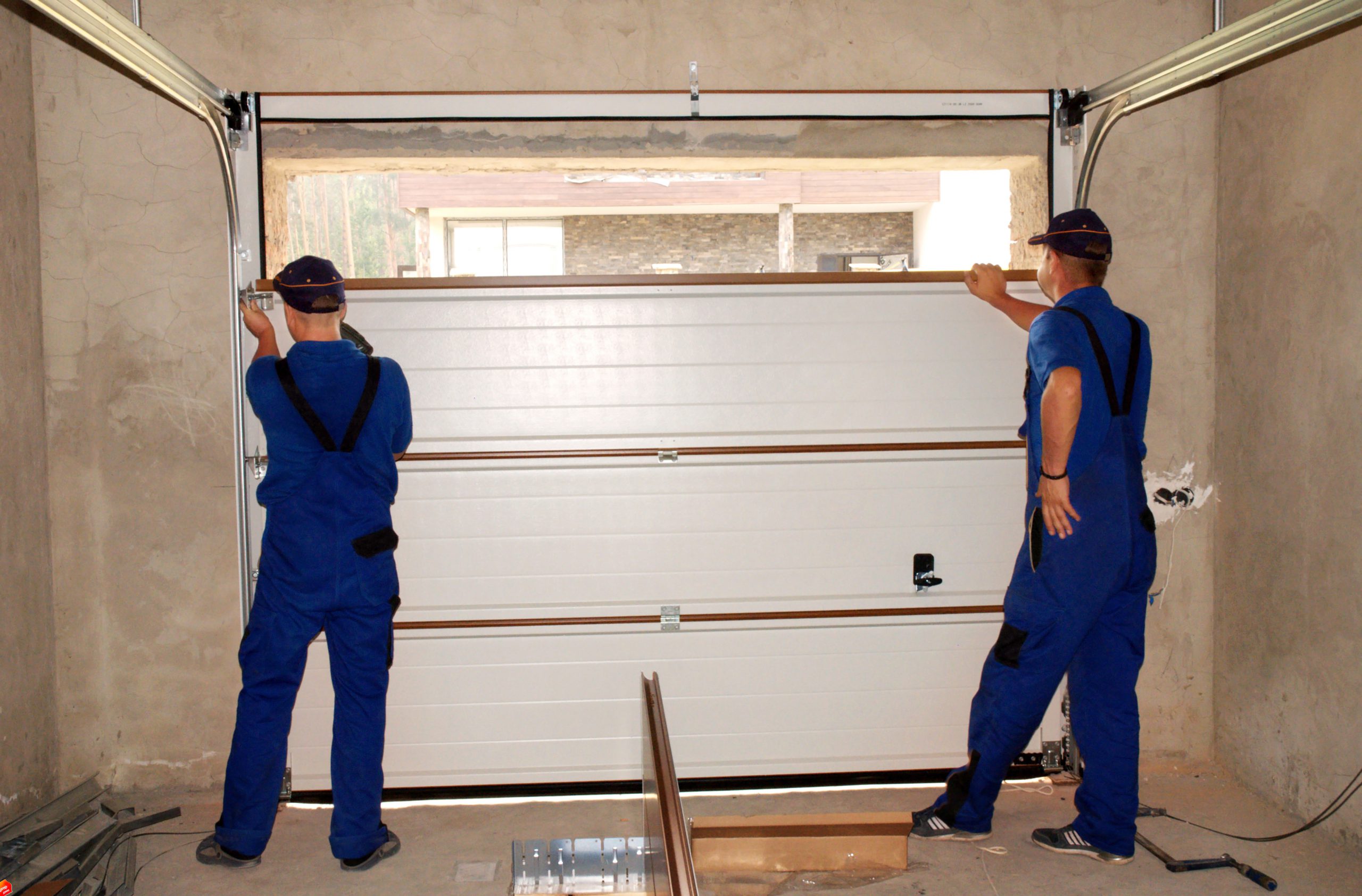
Most people choosing a garage door are really choosing between two mechanisms, even if the showroom conversation is about colours and window inserts. A sectional door folds into horizontal panels and travels back along tracks under the ceiling. A roll-up door curls into a drum above the opening. Everything else — insulation, finish, opener compatibility, how it behaves in twenty years — follows from that one difference.
They are not interchangeable, and the deciding factor is usually the shape of your garage rather than your taste.
How each one actually works
Sectional
Three to five hinged panels run on vertical tracks up each side of the opening, then curve onto horizontal tracks that extend back into the garage. Rollers carry the panels; springs counterbalance the weight so the opener only has to overcome friction and inertia rather than lift the whole door. This is the standard residential door across most of Canada.
Roll-up
Instead of panels that stay flat, the door is made of narrow slats or a continuous curtain that wraps around a barrel mounted above the opening. Nothing travels back into the garage. You see these on commercial units, storage facilities, laneway garages and anywhere the ceiling is already committed to something else.
The question that decides it: headroom and backroom
Before any discussion of material, measure two things.
Headroom is the distance from the top of the opening to the ceiling or the nearest obstruction. Backroom is how far back from the opening you have clear ceiling.
A sectional door needs meaningful backroom — roughly the door’s height plus extra for the opener — because the panels end up parked horizontally above your car. It needs relatively little headroom, and low-headroom track kits exist for tight cases. A roll-up needs the opposite: very little backroom, because nothing goes backwards, but a decent block of headroom for the barrel the curtain wraps onto.
So the rule of thumb is: low ceiling but deep garage, go sectional. Tall opening with pipes, storage racks, a loft or a hoist taking up the ceiling, go roll-up. A garage where you want to keep the ceiling clear for storage is a strong roll-up case even if a sectional would technically fit. Getting this wrong is the single most common reason a garage door installation turns into a redesign halfway through.
How they fail differently
Sectional doors
The wear points are springs, cables, rollers and hinges. Springs are the consumable — they are rated in cycles, and a spring that has done its cycles will break, usually with a loud bang and the door stuck down. Cables fray where they wind onto the drum. Rollers wear and start to bind, which is what makes a door noisy and eventually pulls it out of alignment. Individual panels can be replaced when one gets hit, which is a real advantage.
The upside of this failure mode is that it is well understood and almost all of it is serviceable. A broken spring is a bad morning but a routine garage door spring repair, not a new door.
Roll-up doors
The failure points are the curtain, the side guides and the barrel assembly. Slats can get bent, and because the curtain has to flex to roll, a bent slat does not just look bad — it can jam the whole door mid-travel. The curtain can come out of its guides, especially if the door has been forced or hit. Debris and corrosion in the side guides cause binding. Repairs are often less modular: you cannot always swap one slat the way you swap one sectional panel, and a damaged curtain can mean replacing more of the door.
Insulation, weather and noise
If the garage is attached to the house, insulated, or doubles as a workshop, this matters. Sectional doors are straightforwardly better insulated — each panel can be a sandwich with a foam core, and the perimeter seals against a flat surface. Roll-up doors, especially slat types, have a seam between every slat and are harder to seal well. Insulated roll-up products exist, but they are heavier and the comparison rarely goes in their favour on thermal performance alone.
Noise follows the same pattern. A sectional door on good nylon rollers, properly adjusted, is quiet. A roll-up curtain running in metal guides is inherently noisier. In an attached garage with a bedroom above it, that is not a minor consideration.
Security and durability
Both can be secure and both can be weak; it depends on specification rather than mechanism. Sectional doors are defeated at the opener or by levering a panel, so the relevant details are the lock, the emergency release, and whether the panels are rigid enough to resist prying. Roll-up doors resist prying well because there is nothing to lever, but the weak point is the bottom bar and its locks, and a thin-slat curtain can be damaged.
On durability in a Toronto climate, the honest comparison is that both do fine if drainage is right and the hardware is maintained. Where it tips is impact: a laneway or alley door that gets brushed by vehicles survives better as a roll-up, while a suburban double garage that occasionally takes a basketball is better off sectional because you can replace one panel.
Opener compatibility
Standard residential openers are built around sectional doors and work with them without thought. Roll-up doors in a residential setting often need a different drive arrangement — frequently a tube or jackshaft motor rather than a trolley on a rail — because there is no horizontal track to mount a rail to. If you are replacing a door and keeping your opener, this is worth confirming before anything is ordered, because an opener that cannot drive the new door is an avoidable surprise.
So which one
Choose sectional for an attached residential garage with reasonable backroom, especially if it is heated or insulated, if noise matters, or if you want panel-level repairability. Choose roll-up where the ceiling is needed for something else, where backroom is genuinely short, where the opening is unusually wide or tall, or where the door is in a tight laneway and takes knocks.
If both would fit, sectional is usually the better residential choice on insulation, noise and repair economics — which is why it dominates the residential garage door market. Roll-up wins on space, and when space is the constraint it wins decisively.
FAQ
Can I replace a sectional door with a roll-up in the same opening?
Usually yes, and it is a common move when a ceiling gets claimed by storage or a car lift. You need to confirm headroom for the barrel and that the opening can take the side guides and the barrel’s weight. The opener almost always has to change too.
Which one lasts longer?
Neither has a clear edge over the whole assembly, because what wears out is hardware rather than the door. Springs on a sectional and guides and curtain on a roll-up are the consumables. What actually drives lifespan is cycle count and whether anyone maintains it — a door used eight times a day ages far faster than the same door used twice.
My sectional door is noisy. Does that mean it needs replacing?
Almost never. Noise is normally worn rollers, dry hinges, or loose hardware, and all three are serviceable. Grinding or a sudden change in noise is worth looking at promptly, because it often precedes a cable or roller problem that will leave the door stuck.
Is a roll-up door less secure?
Not inherently. It resists levering better than a sectional does. Its vulnerable point is the bottom bar and the locks that hold it down, so that is where specification matters. A well-specified roll-up and a well-specified sectional are both reasonable; a cheap version of either is the actual risk.
Do I need to do anything seasonally?
Keep the tracks or guides clear, check that the door closes fully onto its seal, and test the safety reverse. In winter, the thing that causes most call-outs is the bottom seal freezing to the slab — clearing snow and ice away from the threshold prevents the opener straining against a door that is stuck down.
Recent Comments