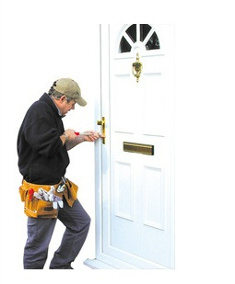
It is nine at night, everyone has gone, and the door will not lock. The key turns and nothing happens, or the bolt goes partway and springs back, or the door simply will not sit far enough into the frame for the lock to engage. Whatever the cause, you now have a building you cannot secure and a decision to make in the next few minutes.
This is a common call, and there is a sensible order to work through before anyone comes out. Some of it you can fix on the spot. The rest is about making the opening safe enough to leave.
First, work out which of three things is happening
Almost every “the door will not lock” situation is one of these, and they have different answers.
The lock mechanism has failed
The key turns freely with no resistance, or will not turn at all, and the bolt does not move. Nothing you do to the door’s position changes anything. Something inside the lock or the cylinder has broken or jammed.
The door is not closing far enough
The lock is fine — it throws normally when the door is open — but with the door shut the bolt hits the strike plate instead of entering it. You may be able to force it by shouldering the door and turning at the same time. This is an alignment problem, not a lock problem, and it is the most common version.
The door or frame is damaged
There is visible distortion, a dent at the edge, a frame that has moved, splintering around the strike, or evidence somebody has tried the door. Alignment and lock are both secondary here.
Spend two minutes on this triage. Open the door, operate the lock with the door open, watch the bolt. If the bolt throws fully and smoothly in free air, your lock is not the problem.
What you can reasonably try yourself
If the bolt will not reach the strike
Look at the strike plate for a bright, scraped mark — that tells you exactly where the bolt is landing and which way it needs to move. Often the door has dropped slightly and the bolt now hits a few millimetres low.
Tighten the hinge screws, especially the top hinge. Decades of use loosen them and the door sags; a screwdriver and two minutes frequently lifts the latch edge back into range. If the screw holes are stripped and the screw just spins, a longer screw that reaches into the framing behind the jamb usually bites.
Check whether something is physically stopping the door: ice or grit on the threshold, a swollen weatherstrip, carpet that has crept, a dropped sweep. In winter the threshold is the usual suspect.
If the lock itself has failed
Do not keep turning the key hard. If a key is binding and you force it, you can snap it in the cylinder and convert a lock problem into a drilling job. If the key turns with no resistance at all, something has sheared and nothing you do at the cylinder will help.
What you can do is check for a second locking point you may not be using — many commercial doors have a deadbolt as well as a latch, and many residential doors have a secondary lock that still works even when the primary has failed. A functioning deadbolt buys you the night.
If there is damage
Do not try to straighten anything. Bending a frame back by hand tends to make the final repair bigger and can leave the door jammed shut, which is worse than jammed open. Photograph it, including the strike area and the door edge, before anyone touches it. Those photos matter for insurance and they help whoever attends arrive with the right parts. Damage from a forced entry is specifically break-in door repair work, and it is worth saying so when you call rather than describing it as a lock that stopped working.
Securing the opening for the night
If it will not lock and nobody is coming until morning, the question becomes how to make the building defensible without creating a different hazard.
Reasonable measures: use any other working lock on the door; secure the opening from the inside and leave by a different door that does lock; move anything valuable and obvious out of sight of the glass; make sure exterior lighting over that door is on; and if you have monitored alarm or cameras, confirm they are armed and actually covering that opening.
What not to do: do not chain or padlock a door that is a required exit while anyone is inside, and do not screw a door shut if it is the only way out of a space. If the building is empty and will stay empty, securing a non-essential door more aggressively is defensible. If anyone is in there — a cleaner, a tenant, someone sleeping upstairs — egress comes first, and that is not a judgement call to improvise on.
For a commercial property, also consider whether leaving it unlocked overnight affects your insurance position. Many policies have requirements about securing premises, and “we could not lock it” is a weaker position than “we secured it and had it repaired”. A same-night emergency door repair often exists precisely to close that gap.
What to tell whoever you call
Being specific shortens the visit considerably. Useful to have ready:
- Whether the bolt moves when the door is open.
- Whether it is a residential or commercial door, and whether it is a fire exit.
- What the door is made of — wood, steel, aluminium and glass — and whether the frame is metal or wood.
- Whether there is a door closer, panic hardware, or any electronic access control on it.
- Whether anything visible is damaged, and whether you suspect forced entry.
- Whether you need it secure tonight or repaired properly, which are sometimes two visits.
That last point is worth being honest with yourself about. Making a door secure at midnight and repairing it correctly are different jobs. A temporary strike, a board-up or a swapped cylinder gets you through the night; the permanent fix may need a part that is not on a van at that hour. Agreeing which one you are buying avoids a lot of friction.
Why doors stop locking in the first place
Very few of these failures are sudden. A door that would not lock tonight has usually been getting harder to lock for months — needing a lift, a shove, a jiggle. Each of those is the door telling you the bolt is no longer entering the strike cleanly, and the lock is wearing against the strike edge every time.
The ones that genuinely do appear overnight are cold snaps, where a threshold freezes or metal contracts enough to shift alignment, and impacts. Everything else gives warning. If any door on a commercial property currently needs persuading to lock, that is the one that will fail at the worst possible time, and dealing with it as routine commercial door repair during business hours is both easier and less disruptive than meeting someone in a parking lot at eleven at night.
FAQ
The key turns but the bolt does not move. What broke?
Usually the connection between the cylinder and the bolt mechanism — a tailpiece, cam or spindle that has sheared or come loose. Sometimes the bolt assembly itself has jammed. Either way it is internal, and continuing to turn the key will not resolve it. In many cases the lock body can be replaced while keeping the existing door and frame.
Can I just put a new lock in myself tonight?
If the old one comes out cleanly and the new one matches the backset and bore, sometimes. The risk is that the reason the old lock failed was alignment, in which case a new lock will not latch either, and you will have spent the evening confirming the frame is the problem. On a fire exit or a door with panic hardware, do not improvise.
Is it safe to leave the building unlocked overnight?
It is a risk assessment rather than a yes or no. An interior door in a secured building is different from the only door to a street. Consider what is inside, what else secures the perimeter, whether the opening is visible and lit, and what your insurer expects. If in doubt, getting it secured the same night is the lower-risk path.
The door only fails to lock in winter. Why?
Cold contracts metal and shifts alignment slightly, moisture at the threshold freezes, and seals stiffen so the door does not compress as far. A door with no margin to spare in summer loses what little it had. The fix is usually to restore proper alignment and clearance rather than to treat it as a seasonal quirk, because the underlying slack is there year round.
How long does this normally take to fix?
Alignment work — hinges, strike, closer adjustment — is typically done in a single visit. A lock replacement is usually one visit if the hardware is standard. Frame or slab damage from a forced entry is often a secure-tonight visit followed by a proper repair once parts are in hand.
Recent Comments