A door that has warped is one of those problems people live with for years. It still opens. It still locks, usually with a shove. But there is a draft along one edge, the weatherstrip only touches in places, and in February you can feel cold air on your ankles from across the room. Warping is not cosmetic. A slab that no longer sits flat in its frame stops sealing, and everything downstream of that seal starts to suffer.
The word gets used loosely, though. Three fairly different problems all get called warping, and they do not share a fix. Telling them apart is most of the work.
What people mean when they say a door is warped
A twisted slab
Twist is the classic warp. The door is no longer a flat plane; it has a gentle propeller shape. Close it and the top corner on the latch side touches the stop while the bottom corner on the same side sits proud of it, or the reverse. You can see daylight at two diagonally opposite corners. Twist develops slowly, which is why most people do not notice it until the weatherstrip gives up.
A bowed slab
Bowing is simpler: the door curves along its height, usually pulling the middle of the latch edge away from the frame. The latch still catches because the hardware is in the middle, but the top and bottom of that edge stand off. A bowed door often still feels fine to use and fails only on air sealing.
A frame that moved
This one is misdiagnosed constantly. The slab is flat and fine, and the opening around it has shifted. Houses settle, sills rot, jambs get kicked, and fasteners work loose over decades. The symptom reads like warping because the gap around the door goes uneven, but the door is innocent. Frame problems are the most common cause of an uneven reveal on older Toronto houses, and they are usually the cheapest of the three to put right if caught before the sill goes.
Why doors warp here in particular
One face wet, one face dry
The main driver is a moisture difference between the two faces of a door. The outside face takes rain, snow and sun; the inside face sits in heated, relatively dry air all winter. Wood and wood composites move with moisture content, so when one face is gaining and the other is losing, the slab cups toward the drier side. A door with a generous overhang above it warps far less than one fully exposed, which is why the same door model behaves differently on two houses on the same street.
Heat on one side only
A dark door facing south or west gets genuinely hot in summer. The outer face expands, the shaded inner face does not, and the slab bows. This is the mechanism behind doors that stick badly in August and then fit acceptably again in October. If a door only misbehaves in one season, thermal movement is the likely culprit rather than permanent damage.
What the door is made of
Solid wood moves the most and keeps moving. Engineered and stile-and-rail doors are more stable but can still twist if the core is inconsistent. Fibreglass and insulated steel barely warp at all, because the skins do not take on moisture — though a steel door can still deform if it has been struck, and a steel skin over a wood frame can delaminate, which looks like warping from a distance. If you are weighing a steel door repair against a replacement, how the skin is attached matters as much as the dent itself.
Diagnosing it without special tools
You need a straightedge and a piece of paper. Hold the straightedge against the door face vertically, down the middle, then down each edge. A gap in the middle means the slab is bowed; a gap at one end only, in different directions on different edges, means it is twisted. If the straightedge sits flat everywhere, the slab is fine and the frame is your problem.
Then close the door on a sheet of paper and pull. Do this at six or eight points around the perimeter. Where the paper slides out freely, the door is not touching the weatherstrip. Mark those spots. A warped slab gives you a run of loose points along one edge, usually continuous. A frame problem tends to give you loose points that follow a corner or one whole side including the hinge side — and the hinge side going loose is a strong frame signal, because a warping slab rarely pulls away from its own hinges.
One more check: open the door halfway and look at the gap between the slab and the hinge jamb, top and bottom. If that gap is noticeably wider at the top, a hinge is pulling out or the jamb has moved. That is door frame repair territory, not a slab issue.
What actually fixes each problem
Mild twist and bow: move the stop, not the door
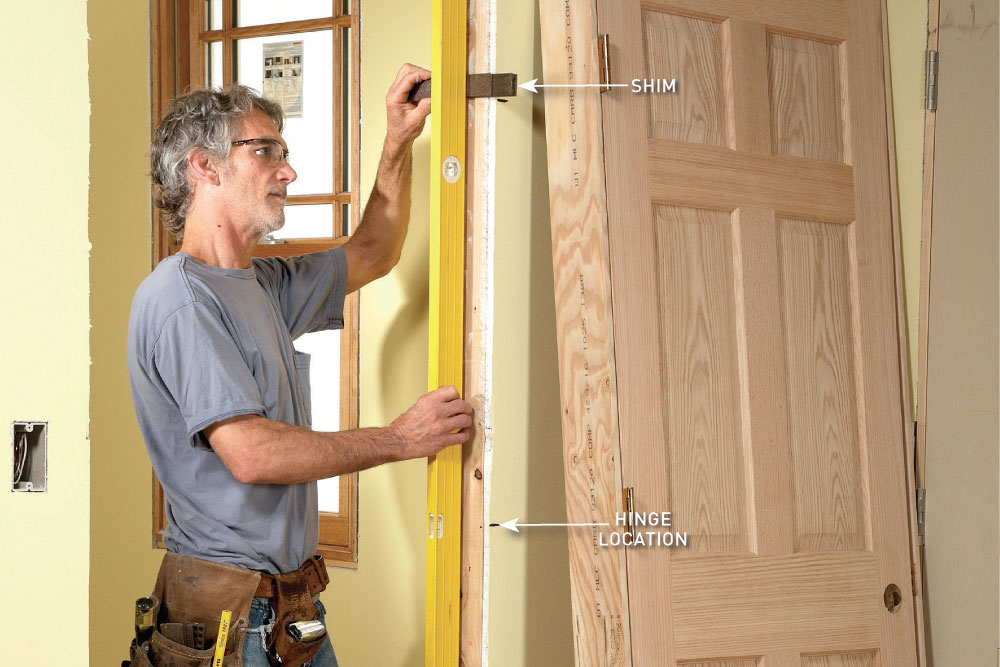
You cannot untwist a door by force, and clamping it flat does not hold. What you can do is bring the sealing surface to the door. On many frames the weatherstrip sits in a kerf that can be adjusted, or the stop itself can be shimmed and refastened to follow the slab’s new shape. Moving the strike plate slightly and adding an adjustable strike lets the latch pull the door in harder at the middle, which closes a mild bow. Hinge shimming — a thin shim behind one leaf — can take a surprising amount of twist out of how the door meets the frame, even though the slab itself is unchanged.
This is the fix that gets skipped most often, and it resolves a large share of warped-door complaints. The door is still warped. It just seals again.
Severe twist: the slab has to go
Past roughly a centimetre of twist across the diagonal, adjustment runs out of room. You can shim the stop that far, but the door starts to look wrong and the latch geometry gets unreliable. At that point the honest answer is a new slab in the existing frame, assuming the frame is square and sound. Reusing a good frame keeps the job much smaller than a full unit replacement.
Frame and sill work
If the opening has moved, the slab is irrelevant until the frame is fixed. That can mean re-anchoring a jamb, replacing a rotted section of the sill or the bottom of a jamb leg, or in bad cases resetting the whole frame plumb. Sill rot is the one not to defer — once water is getting into the subfloor, the repair stops being about the door. Most residential door repair calls that start as “my door is warped” end up including at least some frame attention.
When replacement is the honest answer
Replace when the slab is twisted beyond adjustment and the core has started to come apart; when a wood door has rot at the bottom rail, because that end grain will keep drinking water; when a steel skin has delaminated from its frame; or when the frame itself is out of square enough that a new slab would not fit it properly. Repair when the slab is flat and the frame moved, when the twist is mild, or when the problem is seasonal and reverses on its own.
A door that has warped once in a given exposure will tend to warp again if nothing else changes. If the same door has been replaced twice in the same opening, the thing to look at is not the door — it is the overhang, the drainage, and whether the material suits a fully exposed position.
FAQ
Can a warped door be straightened?
Not reliably. Wood can be coaxed slightly with controlled moisture and clamping, but it rarely holds once the door goes back into service with one face warm and dry and the other exposed. Adjusting the frame and hardware around the warp is the durable approach.
My door fits in winter and sticks in summer. Is it warped?
Probably not permanently. Seasonal sticking that fully reverses is thermal and moisture movement, which is normal. It is worth easing the edge slightly where it binds rather than planing aggressively, because material taken off in August is a gap in January.
Will a new weatherstrip fix a warped door?
Sometimes, for a mild bow. A bulb or compression seal with more travel can bridge a small inconsistency that a thin seal cannot. It will not cope with real twist, and over-compressing a seal to force a fit just makes the door hard to close and wears the seal out quickly.
Does a warped door affect the lock?
Yes, and it is worth taking seriously. When a slab is twisted, the bolt enters the strike at an angle and bears on one side of the opening. You feel it as needing to lift or push the door to turn the key. That side loading wears the latch and can eventually leave you unable to lock up at all, which is why a door you have to shove to lock deserves attention before it strands you.
How long does this kind of repair take?
Adjustment work — hinges, strike, stop, weatherstrip — is typically a single visit. A slab swap in a sound frame is also usually one visit once the door is on hand. Frame or sill repair varies a great deal with what is found once the trim comes off, so it is reasonable to expect that assessment before a firm scope.
Recent Comments