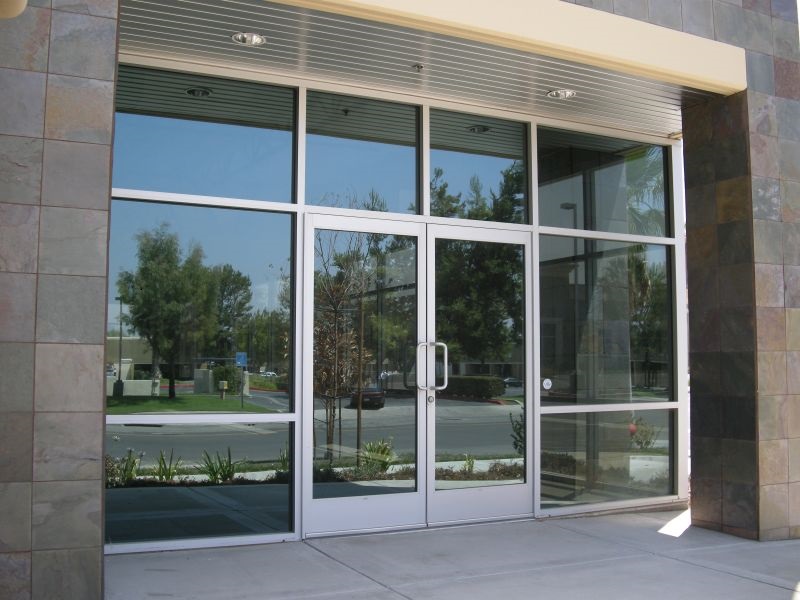
The door itself is fine. It opens, it locks, it seals. The problem is the tall panel of glass next to it, which now has a crack running up from the bottom corner, or has gone permanently cloudy in a way no amount of cleaning touches. It looks like a small thing and it is strangely hard to get a straight answer about.
Part of the confusion is vocabulary. Most people call it “the window beside the door,” which does not help when they phone for a quote. The answer to “can you just replace the glass?” depends almost entirely on which kind of panel you have and how it was built.
What these panels are called
The narrow fixed panel on one or both sides of an entry door is a sidelite (often spelled sidelight). The horizontal panel above the door is a transom. Glass set into the door slab itself is a lite or a decorative glass insert, and it is usually a self-contained cassette rather than loose glass.
These are three different repairs. A sidelite is effectively a fixed window in its own frame, joined to the door frame as part of one assembly. A transom sits above the head. A lite inside the slab is part of the door. Telling the right one apart on the phone saves a wasted visit, so it is worth looking before calling.
Fogged and cracked are not the same problem
Fogged means the sealed unit has failed
Almost all modern sidelites and transoms are insulated glass units: two panes with a sealed, dry space between them. That seal is what keeps the cavity dry. When it fails, humid air gets in, and moisture condenses on the inner surfaces where nobody can reach it.
The signs are distinctive. The haze appears between the panes rather than on a surface you can wipe. It often comes and goes with temperature, worst on a cold morning or in direct sun. Over time it leaves a permanent mineral film, sometimes visible as streaks or a tide line. There is no repair for a failed seal — attempts to drill and vent a unit do not restore the insulating gas or the clarity. The glass unit gets replaced.
Cracked means something moved or something hit it
A crack is mechanical. The useful question is not “how do we fill it” — cracks in a sealed unit are not repairable either — but why it cracked, because that determines whether the replacement will last.
Why glass cracks when nothing hit it
Homeowners are often certain nothing struck the glass, and they are often right. Three causes account for most of it.
Thermal stress. One part of the pane heats in sun while an adjacent part stays shaded and cold — by a shadow line, a snow bank, or a sticker or film applied to the glass. The differential expansion starts a crack at an edge, and thermal cracks have a recognisable look: they begin perpendicular to the edge and then wander in a gentle curve.
Frame movement. Entries settle. If the frame is twisting, or the sill has rotted and dropped, the glass is being asked to carry load it was never meant to. These cracks tend to start at a corner. Replacing the glass without addressing the frame means doing it twice.
Installation stress. A unit set without proper setting blocks, or packed too tightly into its opening, has nowhere to expand. This shows up months or a year after an installation rather than immediately.
So can just the glass be replaced?
Usually yes, on a sidelite with removable stops
Most sidelites are glazed with a removable trim bead — a stop — on one side. The stop comes off, the old unit comes out, a new sealed unit of the same thickness and build goes in on fresh setting blocks, and the stop goes back. The frame stays, the door stays, nothing else changes. This is the straightforward case and it is the most common one, which is why glass door repair on a residential entry is usually glass-only work.
Sometimes no, when the glass is captured
Some sidelites, especially older aluminium-clad and certain fibreglass systems, have the glass captured in a frame that was assembled around it, or bedded in a sealant that was never intended to be opened. Where there is no serviceable stop, replacing the glass means replacing the sidelite panel. A technician can tell from the inside and outside profiles in a few minutes.
Decorative lites in the door slab are a different animal
If the cracked glass is inside the door itself, it is usually a factory cassette: the glass, its internal grilles or caming, and a surrounding plastic or composite frame, made as one part. The cassette is removed by taking out the screws around its perimeter and a new one goes in. The catch is availability — a discontinued decorative pattern can be hard to match, and that is the main reason these jobs sometimes end in replacing the door. Where the pattern is still made, it is a clean swap; where it is not, glass door replacement becomes the realistic conversation.
What has to go back in: safety glazing
Glass in and immediately beside a door is a location where people walk into it, trip into it and put a hand through it. Building requirements treat those positions as subject to human impact and expect safety glazing — tempered or laminated glass — rather than ordinary annealed glass.
Practically, this means the replacement is not simply “a piece of glass cut to size.” The unit has to be ordered to the right dimensions, thickness, build and glass type, which is also why it is ordered rather than carried on the truck. Expect a measure visit and then an install visit.
It also means a cracked sidelite should be treated with a little respect in the meantime. Tempered glass that has been compromised can let go all at once rather than gradually, and the fragments go everywhere.
The security question nobody asks until later
A sidelite is a sheet of glass within arm’s reach of your deadbolt. Replacing the glass is the natural moment to think about that, because the cost difference between options is smallest while the stop is already off.
Laminated glass is the straightforward improvement: it holds together when broken because of the interlayer bonding the panes, which makes reaching through it far harder than reaching through tempered glass. If the entry also has a thumbturn deadbolt directly reachable from the sidelite, that is worth reviewing at the same time. Broader glass door options are worth a look before the order is placed rather than after.
When the whole unit should go
Glass-only replacement is the right answer most of the time. A few situations point the other way: the frame or sill is rotted or no longer square, so new glass would be stressed from day one; multiple units in the same entry have fogged, which suggests the assembly is at the end of its service life; the panel is a captured design where glass cannot be separated; or the decorative pattern is unavailable and nothing close enough exists. In those cases replacing the glass is money spent on a short reprieve.
What the visit actually involves
A straightforward sidelite job runs in two stages. First a measure: exact sizing of the unit, confirmation of thickness and build, a look at the stops to confirm the glass is serviceable, and a check of the frame and sill for movement or rot. Then, once the unit arrives, the install: old unit out, opening cleaned, new setting blocks, unit bedded and the stop replaced, with the glazing seal checked all round.
If the frame needs attention, that happens before the new glass goes in rather than after. Glass is the last thing into a repaired opening, not the first.
Frequently asked questions
Can a crack be filled or stopped from spreading?
No. Resin repairs belong to laminated automotive windscreens, which are built differently. On a residential sealed unit the glass is replaced.
My sidelite is only fogged. Can I leave it?
You can — a failed seal is not a safety issue. You lose some insulating value and the haze gets worse, and the mineral staining eventually becomes permanent. It is a comfort and appearance decision rather than an urgent one.
Why is a narrow sidelite not cheaper than a window?
Because the cost is in a made-to-order insulated unit in the correct safety glass, plus two visits. The square footage is small; the process is not.
Can I board it up in the meantime?
Yes, and with a crack in tempered glass it is sensible. Cover both sides so that if it lets go the fragments are contained, and avoid taping anything dark directly onto glass in sun, which is its own thermal stress risk.
Will the new glass match the old?
Clear glass matches easily. Obscure, textured, bevelled and leaded patterns are where matching gets difficult, and this is the single most useful thing to photograph before you call.
Does one fogged panel mean the others will follow?
Not necessarily, but units installed at the same time have had the same exposure for the same number of years. If one has failed, it is reasonable to look closely at the rest rather than assume they are fine.
The short version
Fogged means a failed sealed unit and the glass gets replaced. Cracked means something moved or struck it, and the cause matters more than the crack. Most sidelites and transoms are glass-only repairs; captured panels and discontinued decorative lites are the exceptions. Whatever goes back in has to be safety glass — and since the stop is already off, that is the cheapest moment to ask whether laminated is the better choice next to your lock.
Recent Comments