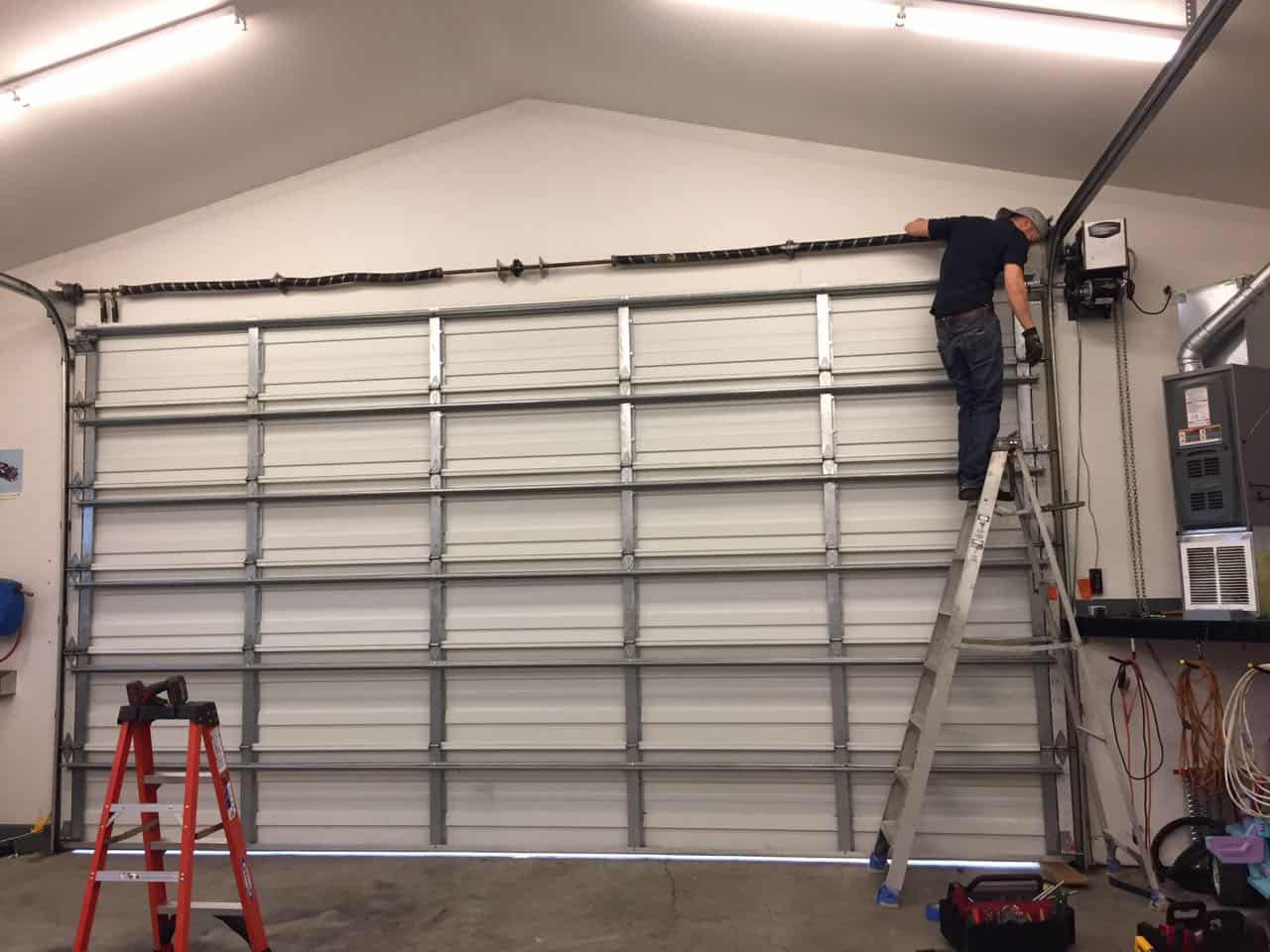
A garage door is the loudest moving part of a house, and the sound it makes is the best diagnostic tool most owners have. Long before anything breaks visibly, the noise changes. Learning to tell a squeal from a grind from a pop means you call someone while it is still a small job.
Here is a sound-by-sound breakdown, what each one usually points to, and the two noises that mean the door should not be used again until it has been looked at.
Start by separating the opener from the door
Most people describe every noise as the opener, because that is the thing with a motor in it. Half the time the opener is innocent and simply the loudest witness.
There is a quick test. With the door closed, pull the manual release cord to disconnect the trolley, then lift the door by hand. A balanced door should move with moderate effort and stay roughly put at waist height. If it is heavy, crashes down, or flies up, the spring system is the problem and the opener is just struggling against it. If it glides smoothly and quietly by hand, the noise is coming from the opener or the drive.
Do this with nothing underneath the door and nobody in the way, and if the door feels at all unpredictable, stop and leave it closed.
The sounds and what they usually mean
Squealing or screeching that follows the door up and down
Almost always rollers or hinges. Nylon roller tyres flat-spot with age, steel rollers lose their bearings, and dry hinges chirp at the same point in travel every cycle. The telltale is consistency: the noise happens at the same height each time, going both directions.
This is the cheapest noise on the list to deal with and the easiest to ignore for too long. Worn rollers let the door wander in the track, which puts side load on the cables and wears the track itself.
Grinding from the opener head
If the motor runs but the door barely moves, or moves in jerks while the head unit makes a dull grinding sound, the drive is slipping. On a chain or belt drive that often means a worn sprocket or a stretched chain. On a screw drive it can be a dry or galled shaft. On many older units it is a stripped plastic drive gear, which is a known wear part.
A motor that hums with no movement at all is a different fault — usually a seized gear, a failed capacitor, or a door so far out of balance that the opener cannot shift it. Either way, repeatedly trying it just cooks the motor. The diagnosis belongs with whoever handles your garage door opener work.
Popping or banging while the door travels
Short, hard pops as the door moves usually mean sections are flexing against each other, or a bent track is forcing a roller through a tight spot. Look along the track with the door closed and then half open. A dent, a loose bracket or a section joint that has worked loose will show.
Popping that comes specifically from the spring on the shaft above the door is different and more serious. Torsion springs make a loud metallic pop when they slip or when a cone has shifted on the shaft.
Rattling and vibration
Usually hardware that has shaken loose over thousands of cycles. Track brackets, hinge bolts, the opener rail hangers, the mounting bracket at the header. Rattle that gets worse over weeks is loose fasteners; rattle that appeared overnight is a part that has broken or shifted.
Scraping along one side
The door is out of alignment. Either the tracks are no longer parallel, or one cable has stretched or slipped on its drum so the door rides crooked. A crooked door drags on one track and climbs on the other, and the wear accelerates quickly once it starts. Cable problems need garage door cable repair rather than adjustment, because a stretched cable does not come back.
Two sounds that mean stop using the door
These are the ones worth memorising.
A single loud bang from the garage when nobody was operating the door
That is the classic broken torsion spring. People describe it as a gunshot or something heavy falling. Afterwards the door usually looks fine and closed, and the opener may even still run — which is the dangerous part, because the door now weighs its full weight with nothing counterbalancing it.
Do not try to lift it, do not run the opener, and do not park under it. A broken spring is replaced in pairs on a two-spring door and it is work for someone with the right winding bars and the experience to use them. Garage door spring repair is the single job on a garage door where a shortcut causes serious injuries every year.
A snap followed by the door sitting crooked
That is a cable letting go. One side drops, the door jams in the track at an angle, and the remaining cable is now carrying everything. Leave it where it is, disconnect nothing, and keep people away from under it.
What you can safely do yourself
Tighten the hardware you can reach with a spanner, with the door closed and the opener unplugged. Vacuum the tracks and wipe them dry — do not grease them. Put a dry lubricant on roller bearings and hinge pins. Check whether the photo-eye sensors are clean and facing each other. Watch the door through a full cycle and note where any noise starts.
What to stay away from: anything on the spring shaft, anything involving the cables or the drums, and adjusting the opener force settings to make a struggling door work. That last one is common and it removes the safety margin that was protecting the door and the people under it.
Frequently asked questions
My garage door is suddenly much louder than it was. Is that urgent?
A gradual increase over months is usually rollers and hardware. A sudden change over a day or two means something moved or broke, and it is worth looking at promptly before the door comes out of alignment.
Can I just lubricate the noise away?
Sometimes, if it is a dry hinge or roller bearing. If the noise returns within a few weeks, the part is worn, not dry.
Why is my door noisy only in cold weather?
Lubricant thickens, metal contracts, and nylon rollers get harder and noisier in the cold. Doors also tend to be slightly out of balance all year and only reveal it when the opener has to work harder.
Is a humming opener about to fail?
A hum with no movement usually means it is already failing or the door is binding. Stop operating it and have it checked, because repeated attempts against a stuck door are what kills the motor.
How often should a garage door be serviced?
Once a year suits most households, and more often for a door that cycles several times a day. The service that matters most is the balance check, because an out-of-balance door quietly destroys everything else attached to it.
Recent Comments