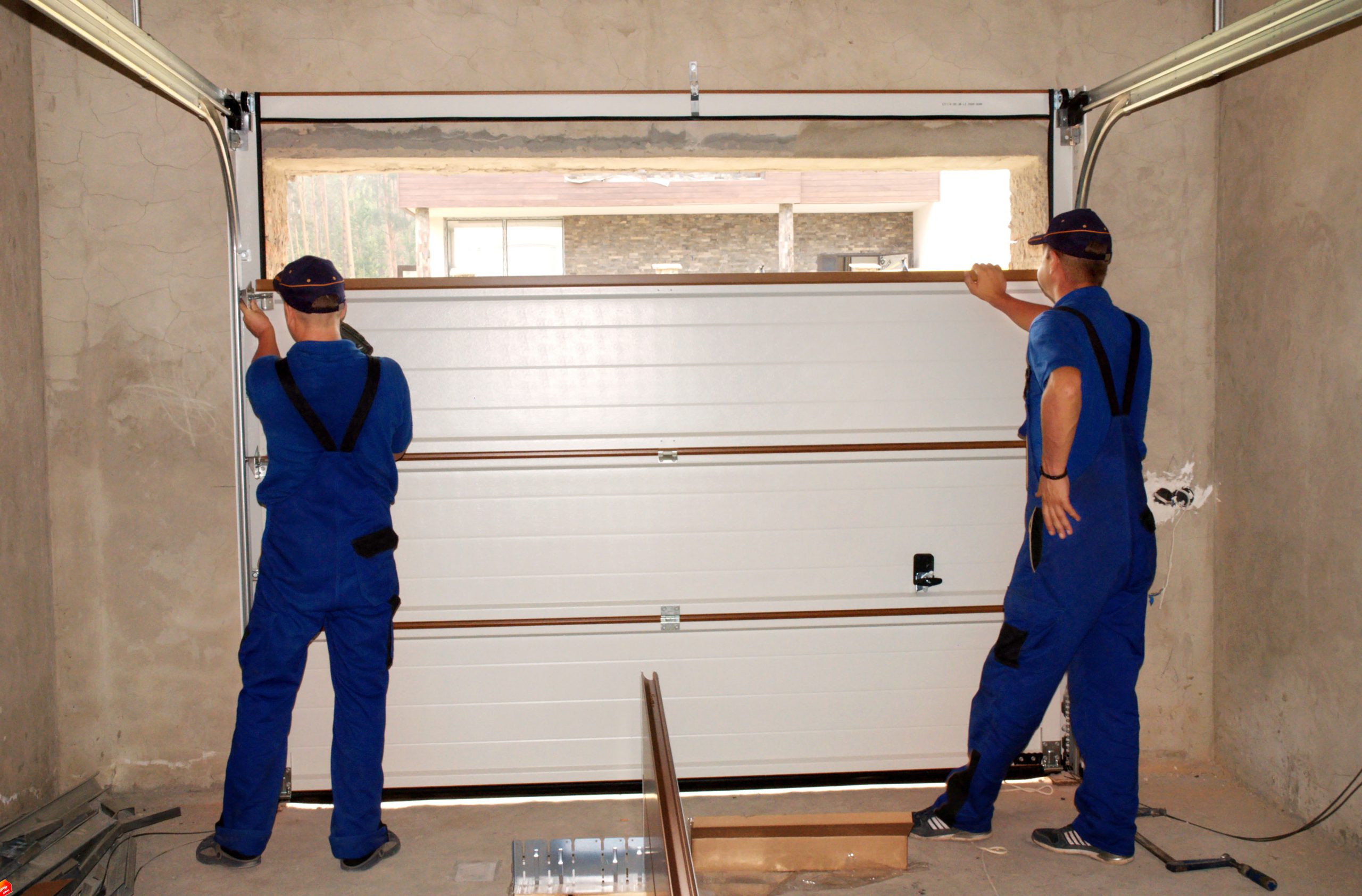
Someone backs into the bottom section. A hockey net gets left against the door and the wind does the rest. A tree branch comes down in an ice storm and leaves a crease across two panels. In every one of those cases the first question is the same: can you just swap the broken section, or is the whole door finished?
The honest answer is that it depends on four things, and none of them is how bad the dent looks. A door with a badly crushed bottom panel can be a single-section job, and a door with a modest crease across the middle can be a replacement. Here is what actually drives the decision.
What a single section actually does
A sectional garage door is not a flat slab with lines drawn on it. Each section is a structural element: it carries the hinges that tie it to the sections above and below, it holds the roller brackets that keep the door in the track, and on the bottom section it holds the bracket that the lift cables attach to. The whole stack behaves as one beam when the door is halfway up.
That is why a dent is not just cosmetic. If the steel skin is creased but the internal strut and the end stiles are straight, the section still does its structural job. If the stiles are bent or the strut is kinked, the section no longer holds its shape under load, and the hinges either bind or pull.
The four questions that decide it
Can that section still be bought?
This is the one that ends most conversations. Garage doors are made in specific panel designs, embossing patterns, window configurations and colours, and manufacturers discontinue them. A door from the mid-2000s may have no matching section available at all, or only in a pattern that is visibly different. You can fit a section that works mechanically and still have a door that looks patched from the street.
How many sections are involved?
One section is a straightforward repair. Two can still make sense. Once you are at three on a four-section door, you are rebuilding most of the door around its oldest parts, and a new garage door installation usually wins on both cost and outcome.
Is the damage only in the skin?
Press on the dented area and look along the inside face of the section. A dent in the outer skin with an intact strut behind it is a cosmetic problem. A section that has lost its straightness along the top or bottom edge is a mechanical one. The giveaway is the hinge line: if the hinges no longer sit flat against both sections, the geometry has moved.
What shape is the rest of the door in?
The section you are replacing is new. Everything around it is as old as the door. If the other sections are rusting along the bottom edge, if the end stiles are perforated where the roller brackets bolt on, or if the hinges have worn their holes oval, a new section will be the strongest part of a weak assembly. That is a short-lived fix.
Why a mixed-age door behaves differently
A replacement section rarely weighs exactly what the original did. Gauge changes, insulation changes, and manufacturers revise their designs. A door that is a few kilograms heavier or lighter than it was is no longer balanced against its springs, and an unbalanced door tells you so: it drifts down when you stop it halfway, it slams the last foot, or the opener strains at the top of travel.
This is the step most often skipped. After any section change, the door needs to be re-balanced, which usually means adjusting spring tension and sometimes means the springs are simply no longer right for the new weight. If the door does not hold its position when released halfway, the spring side of the system needs attention before anyone calls the job finished.
When a whole new door is the cheaper decision
- The door is near the end of its service life anyway. Paying for a section on a door you will replace in two years is paying twice.
- The pattern is discontinued. A visible mismatch on the front elevation of a house is not a small thing, especially before a sale.
- You want something the old door cannot give you. More insulation, a quieter build, a different window layout, or a design that suits the house better. Comparing what is available across current sectional garage door options is worth doing before committing to a repair.
- The frame or jamb took damage too. If the vehicle hit hard enough to move the track or the wood jamb, the door is only part of the work.
What a technician checks before answering
A useful assessment takes a few minutes and does not happen over the phone. The things being looked at:
- The manufacturer and model plate, usually on the inside of a section or near the track — this is what determines parts availability
- Whether the end stiles and struts are straight, not just whether the skin is dented
- Whether the door still runs its full travel without binding at the curve
- How the door sits when released at waist height, which tells you about balance
- The condition of hinges, rollers and the bottom brackets on every section, not only the damaged one
Ask for the model information even if you decide to wait. It is the single piece of data that makes the next conversation fast.
Frequently asked questions
Can a dent be pulled out instead of replacing the section?
Small dents in the skin of a steel door can sometimes be improved, but the result is usually visible in raking light and the paint finish rarely survives the process. It is a reasonable option on a garage that faces a laneway, less so on a front elevation.
Does replacing one section void anything?
Manufacturer coverage terms vary by brand and by what caused the damage, and impact damage is normally treated differently from a manufacturing fault. Check the paperwork for your specific door rather than assuming either way.
Will a new section match the colour of the old ones?
If the design is still made, the colour will be the factory colour — which is not the same as the colour of a door that has faced ten Ontario summers. Expect a difference, more noticeable on darker colours.
Is the door safe to use with one damaged section?
If the section has lost its structural shape, no. A bent section can let a roller leave the track, and the door is heavy. If the door binds, scrapes or has visibly moved out of plane, leave it closed and operated by hand until it is looked at.
The short version
One section, intact stiles, a design still in production and a door that is otherwise sound: replace the section and re-balance the door. Multiple sections, a discontinued pattern, rust elsewhere, or a door already past its useful years: replace the door and stop spending on the old one.
Recent Comments